Skip to content

Free · No equipment to start · 30 minutes

Calisthenics
Workout Plans

Four plans built on five movement ladders. Test where you actually are, train the rung you land on, and move up when you hit the number — not when you get bored.

4
plans
5
movement ladders
30
minutes a session
0
equipment to start

A plan is not a list of exercises. It is a rule for what you do next.

A calisthenics workout plan is a schedule for bodyweight training: which patterns you train, how often, how many sets, and the exact condition that tells you to make them harder. The movements are the easy part — push, pull, squat, brace, dip. What separates a plan from a workout you found this morning is the progression rule attached to it.

That rule is what this site is built around. Every plan below stands on five movement ladders, and every ladder states the number that earns you the next rung. You never have to wonder whether you have outgrown a variation. The number answers it.

Military Calisthenics Coach app icon

Now on iPhone

Military Calisthenics Coach

Free · Health & Fitness · iPhone

Your plan, in your pocket

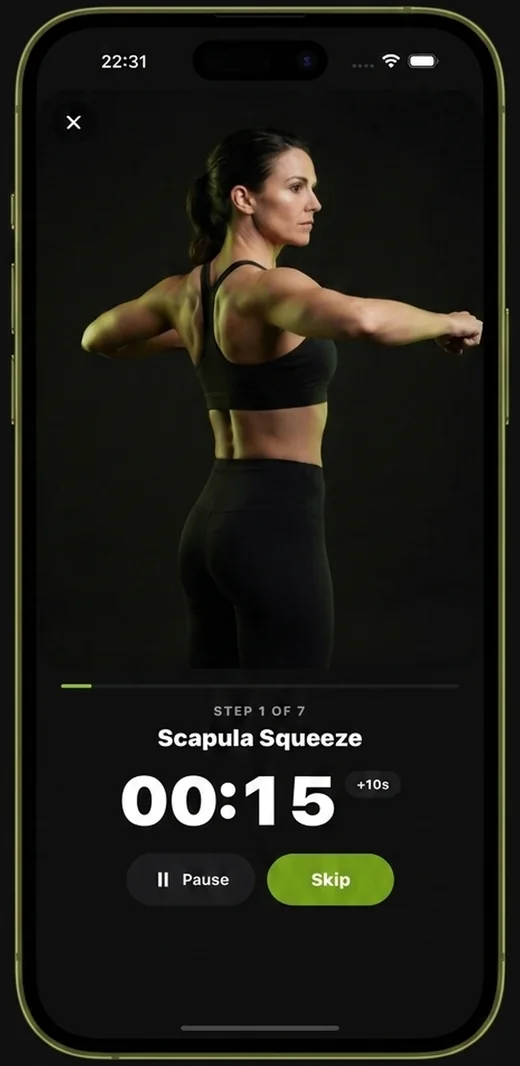
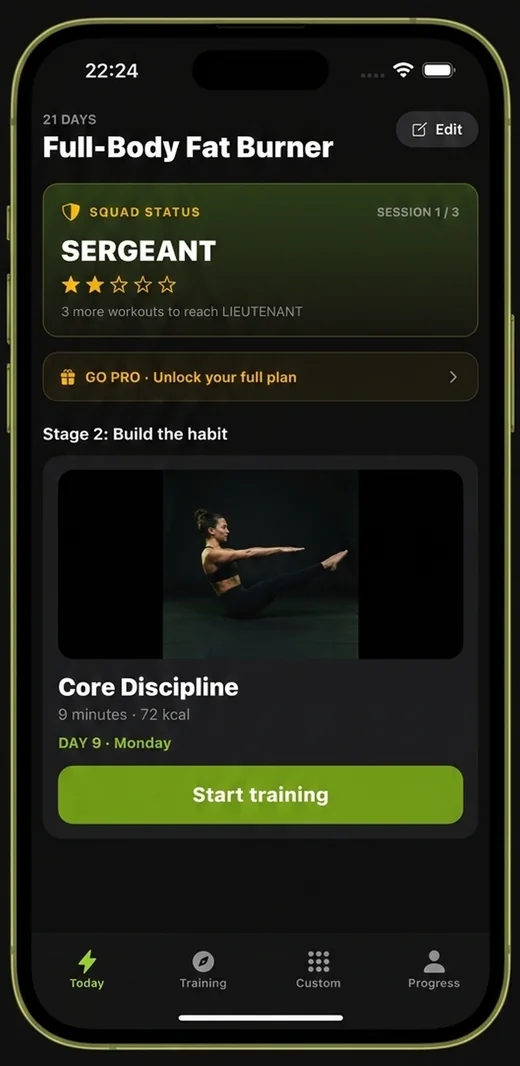
Every plan on this site, built into a coach that runs the session for you. Military Calisthenics Coach turns the progressions into a daily workout you can do in a park, a garage or a hotel room — timed, tracked and scaled to your level.

  • A 21-day program that adapts to your level
  • Guided timed sessions — no counting, no guessing
  • Ranks, streaks and progress you can actually see
Download Military Calisthenics Coach on the App Store
Military Calisthenics Coach guiding a timed push-up setMilitary Calisthenics Coach showing today's session and rankMilitary Calisthenics Coach progress tab with streak and workout history

01 / Start here

The four-rep test

Most people pick a plan by ambition and quit in week three. Pick by evidence instead. Four tests, ten minutes, two minutes of rest between each — and one honest answer about where you start.

T1 reps

Push-ups

Maximum clean reps in one set. Chest to a fist’s height off the floor, hips in line with your shoulders, no resting at the top.

T2 seconds

Dead hang

Hang from a bar with straight arms and active shoulders. Stop the clock the moment your grip starts to slide.

T3 reps

Pull-ups

Strict, from a full dead hang, chin clearly over the bar. No kipping, no swinging, no half reps at the end.

T4 seconds

Squat hold

Sit at the bottom of a squat with your heels flat and chest up. Stop when a heel lifts or your lower back rounds.

Read your result

If your numbers say Start with Why
Under 10 push-ups, or a hang shorter than 15 seconds Foundation You need the base before the split is worth anything.
10–24 push-ups, 0–4 pull-ups, 20-second hang Build Enough of a base to split the week and add real volume.
25+ push-ups and 5+ strict pull-ups Ladder Strength is no longer the limit — skill work is.
Solid on all four, but a flight of stairs still wins Engine Strength outran conditioning. Close the gap.

Retest in four weeks. Same order, same day of the week, same rest.

02 / Progression

Three ways to make bodyweight harder

You cannot add five kilos to your own body. These are the three things you add instead, in the order you should reach for them.

01

Leverage

Change the angle or the length of the lever so the same muscles carry more of your bodyweight. This is the biggest jump available and the one to reach for first.

Incline push-up → push-up → decline push-up

Use it when you can clear the top of your rep range with clean form on the current rung.

02

Tempo

Keep the movement, add time under tension. A three-second lowering turns a set of ten into a set you feel by rep six, with no change of equipment and no change of variation.

10 fast push-ups → 10 with a 3-second lowering

Use it when you are stranded between two rungs and the next one is still out of reach.

03

Density

Same sets, same reps, less rest. The session gets harder without a single new exercise — and it gets shorter, which is usually the real constraint.

4 sets with 90s rest → 4 sets with 45s rest

Use it when conditioning is the limit. Avoid it when you are chasing maximum strength — short rest caps the load you can express.

03 / The ladders

Five ladders, one rung at a time

Five patterns cover everything the body does without equipment. Each is a ladder: find your rung, own it, step up. The rule on the right is the only permission slip you need.

Push

Move up at 3 sets of 12, clean

  1. 01 Incline push-up
  2. 02 Push-up
  3. 03 Diamond push-up
  4. 04 Decline push-up
  5. 05 Archer push-up
  6. 06 One-arm progression

Pull

Move up at 3 sets of 8, no kipping

  1. 01 Dead hang
  2. 02 Inverted row
  3. 03 Negative pull-up
  4. 04 Pull-up
  5. 05 L-sit pull-up
  6. 06 Weighted pull-up

Squat

Move up at 3 sets of 15, or 8 per leg

  1. 01 Box squat
  2. 02 Air squat
  3. 03 Split squat
  4. 04 Bulgarian split squat
  5. 05 Box pistol
  6. 06 Pistol squat

Brace

Move up at 45 seconds, or 3 sets of 12

  1. 01 Knee plank
  2. 02 Plank
  3. 03 Hollow hold
  4. 04 Hanging knee raise
  5. 05 L-sit
  6. 06 Dragon flag

Dip

Move up at 3 sets of 8, full depth

  1. 01 Bench dip
  2. 02 Band-assisted dip
  3. 03 Parallel bar dip
  4. 04 Ring dip
  5. 05 Weighted dip

04 / The plans

Four plans, one ladder system

Same five ladders in all four — what changes is how the week is cut and which rung you stand on. Start where the test put you, not where your ambition did.

Plan 01

Foundation

Four weeks to a clean push-up and a first pull-up

Three full-body sessions a week, every movement scaled to a rung you can actually hold form on. The goal is not fatigue — it is twelve honest reps of something that was eight sloppy ones in week one.

For
Under 10 push-ups or 0 pull-ups
Length
4 weeks · 3 sessions · 30 min
Gear
None to start; a bar by week 3
  1. Mon Full body
  2. Tue Walk + mobility
  3. Wed Full body
  4. Thu Rest
  5. Fri Full body
  6. Sat Walk
  7. Sun Rest
Plan 02

Build

Push / pull / legs, rebuilt for bodyweight

Once one session can no longer hold everything, split it. Each pattern gets trained twice a week with enough volume to actually grow, and the second session of each pair runs a rung harder than the first.

For
The default plan for most people
Length
8 weeks · 6 sessions · 30–40 min
Gear
Pull-up bar
  1. Mon Push
  2. Tue Pull
  3. Wed Legs + brace
  4. Thu Push (harder rung)
  5. Fri Pull (harder rung)
  6. Sat Legs + brace
  7. Sun Rest
Plan 03

Ladder

Skill work: muscle-up, handstand, front lever, pistol

Skills are a practice, not a reward. They go first in the session while you are fresh, in short sets that stop well short of failure — then the strength work follows. Fatigue is the enemy of every skill on this list.

For
25+ push-ups, 5+ strict pull-ups
Length
Ongoing · 4 sessions · 45 min
Gear
Bar, floor space, patience
  1. Mon Skill + push
  2. Tue Pull
  3. Wed Rest
  4. Thu Skill + legs
  5. Fri Full body
  6. Sat Easy movement
  7. Sun Rest
Plan 04

Engine

Conditioning circuits that keep the strength you built

Two strength sessions hold your ground while three circuits move your conditioning. The circuits are intervals, not a race — you work the clock, rest the clock, and finish able to repeat it tomorrow.

For
Strong but out of breath
Length
6 weeks · 5 sessions · 20–30 min
Gear
None
  1. Mon Strength
  2. Tue Circuit A
  3. Wed Rest
  4. Thu Strength
  5. Fri Circuit B
  6. Sat Circuit C
  7. Sun Rest

05 / The session

What thirty minutes looks like

Every plan runs on the same skeleton. Change the rung, not the shape — which is why the session never needs rewriting, only relabelling.

  1. 00:00 5 min

    Raise and open

    50 jumping jacks, 20 arm circles each way, 20 air squats, 10 leg swings per leg. Finish with two 20-second dead hangs — the cheapest shoulder insurance there is.

  2. 05:00 7 min

    Push

    Four sets on your current push rung, each stopped two reps short of failure, 60 seconds of rest between. The last set should look like the first. If it does not, you picked the wrong rung.

  3. 12:00 8 min

    Pull

    Four sets on your pull rung with 90 seconds of rest. Pull gets the longest rest and the most patience — it is the pattern that decides how the rest of your training looks in six months.

  4. 20:00 5 min

    Squat

    Three sets on your squat rung, alternating with 10 walking lunges per leg. Drive through the heel, keep the chest tall, and add a three-second pause at the bottom before you add reps.

  5. 25:00 4 min

    Brace

    Three rounds on your brace rung. Ribs down, lower back flat, breathing the whole time. A shaking 30-second hollow hold beats a comfortable 90-second plank.

  6. 29:00 1 min

    Close

    Log the rungs and the reps — one line is enough. Next session is not a guess, it is whatever this line says plus one.

06 / Standards

Numbers worth chasing

Checkpoints, not judgements. Clear the beginner column across the board and the Build plan is yours; clear the intermediate column and the skill work starts moving fast.

Test Beginner Intermediate Advanced
Push-ups, one set103050+
Strict pull-ups11020+
Dips31525+
Squat pattern25 air squats10 Bulgarians per leg5 pistols per leg
Brace hold45s plank60s hollow hold20s L-sit
Dead hang20s60s2:00+

07 / Failure modes

Six things that stall bodyweight progress

Almost nobody stalls because the program was wrong. They stall on one of these.

  • 01

    Collecting exercises instead of numbers

    New movements feel like progress and rarely are. Keep the movement, beat the number, then change the rung.

  • 02

    Training pull half as often as push

    Push-ups need no equipment, so they win by default. Match pull sets to push sets every week, or buy the imbalance back in shoulder pain later.

  • 03

    Reps that get shorter as the set goes on

    Rep eight at half depth is not rep eight. Stop the set at the first short rep and log the honest count.

  • 04

    Seven days on, then two weeks off

    The plan that survives a bad week beats the plan that needs a perfect one. Three kept sessions beat six promised ones.

  • 05

    Testing every session

    Max-effort sets tell you where you are, not how to get further. Test on the same day once a month and train the rest of the time.

  • 06

    Skipping legs because there is no barbell

    One leg at a time is the load. Split squats, Bulgarians and box pistols make bodyweight legs hard enough for anyone.

08 / Questions

Straight answers

Can you actually build muscle without weights?

Yes — muscle responds to tension, effort close to failure, and progressive overload, not to the specific object supplying them. What bodyweight training lacks is a small, easy increment: you cannot add 2 kg to yourself. So the overload comes from leverage, tempo and volume instead, which is exactly what the ladders on this page are for. In practice the upper body grows readily; legs need single-leg work to stay challenging.

What if I cannot do a single pull-up?

That is the normal starting point, and it has its own rungs. Spend four weeks on dead hangs and inverted rows, then move to negative pull-ups: jump or step to the top position and lower yourself for five full seconds. Three sets of three negatives, twice a week, gets most people to a first strict rep inside two months. Skip the resistance band if you can — negatives teach the top of the movement better.

How many days a week should I train?

Three full-body sessions with a rest day between each is enough for anyone still building the base, and it is the hardest schedule to fall off. Once those feel routine, the six-day push/pull/legs split gives each pattern twice the weekly volume in shorter sessions. More than six is not better — it just borrows recovery from next week.

Do I need a pull-up bar?

For the first four weeks, no. After that, yes — nothing else trains the pull pattern properly, and a body trained only on push work ends up round-shouldered and imbalanced. A doorway bar, a park frame, a set of rings over a beam or a sturdy table for inverted rows all count. It is the only purchase these plans ever ask for.

Should I train to failure?

Mostly no. Stop two reps short on your working sets: you keep the form, you recover in time for the next session, and the research on hypertrophy shows little benefit to grinding out the last rep. Save true failure for a monthly test set, where the number is the whole point.

How long before I see results?

Endurance and posture shift inside four to six weeks — the first thing most people notice is that the same set stops being hard. Visible strength changes, like adding several strict pull-ups or a first dip, generally land between weeks eight and twelve. Skills such as a free-standing handstand run on a longer clock, usually six months to a year of consistent practice.

Can I run or lift weights alongside these plans?

Yes, with one rule: protect the hard sessions. Put easy runs on rest days or after a session, and keep hard intervals away from the day before heavy pull work. If you also lift, treat these plans as the accessory rather than the main course and drop one bodyweight session a week.

Military Calisthenics Coach app icon

Now on iPhone

Military Calisthenics Coach

Free · Health & Fitness · iPhone

Let the app run the session

Stop planning and start training. Military Calisthenics Coach takes the plans on this page and turns them into a guided, timed session — it counts the sets, holds the rest clock and scales the reps as you get stronger.

  • Every plan on this page, ready to run
  • Timed sets and rests — just follow the screen
  • Streaks, ranks and progress you can actually see
Download Military Calisthenics Coach on the App Store
Military Calisthenics Coach guiding a timed push-up setMilitary Calisthenics Coach showing today's session and rankMilitary Calisthenics Coach progress tab with streak and workout history